General information · not a substitute for the advice of an attorney.
Free · general informationUnited States
Next of kin box template: what goes in it, and where each paper comes from
A next of kin box is one place that holds your papers and says where everything else is. This page is the list of what goes in it, in fifteen categories. You can build one yourself with a file box or a binder from any store.
For each paper it says what it is, which office the official copy comes from, and the mistake to watch for. Each fact shows who said it and the date we read it.
There is a one-page category sheet to print. Below the list is the printable planner we make, for anyone who would rather not start from blank folders.
One place for your papers. One line for where everything else is.
The one-page category sheet
The fifteen categories on one page. A box to tick as each folder is filled. A line for where it is kept. Letter paper. No email.
Prepared and checked by Valoren, a publisher in London, England. No attorney has reviewed it. Checked November 10, 2026.
§1What a next of kin box is
It is a household file with one job. If you die, or cannot speak for yourself, the person who steps in opens it and finds what they need: the papers, the accounts, the people to call.
Your next of kin are your closest relatives, the people who would be told first. The box is for them.
The National Institute on Aging's own checklist starts in the same place.
“Put your important papers and copies of legal documents in one place.”
The name is new. The idea is old. People also call it a death binder, a when I die folder or an in case of death file.
Some companies sell a ready-made one: a box of labeled folders.
Valoren is not affiliated with any of them, and this page does not describe anyone's product. It describes the general idea, which anyone can build at home.
A box like this has no legal power of its own. The will, the powers of attorney and the health care directives are separate signed papers. The box holds them, or says where they are.
Six steps. The list below says what goes in each folder.
§2How to read the list
Fifteen categories. One folder each. Under every item are three short lines.
What it is
One plain sentence.
Where the official copy comes from
The office or company that issues it, in its own words where we have read them, with a link to its page and the date we read it.
Watch out
One mistake people make with that paper.
Much of this is the same across the country. Some of it is set by each state: vital records, advance directive forms, deeds and vehicle titles. Where a state decides, the line says so and points to that state's own pages.
Put a copy in the box and note where the original is. Some originals belong somewhere else, and the list says which.
§3Identity and vital records
These are the papers every office asks for first.
Birth certificate
What it is
The state's record of your birth.
Where the official copy comes from
“Contact your birth state or territory’s vital records office to find out:” “How to order a certified copy of your birth certificate online, by mail, or in person”
Proof of citizenship, for a citizen who has no United States birth certificate.
Where the official copy comes from
“If your Certificate of Citizenship or Certificate of Naturalization was damaged, lost, or stolen, learn how to replace it online or by mail using Form N-565.”
“A durable power of attorney for health care is a legal document that names your health care proxy, a person who can make health care decisions for you if you are unable to communicate these yourself.”
“A DNR becomes part of your medical chart to inform medical staff in a hospital or nursing facility that you do not want CPR or other life-support measures to be attempted if your heartbeat and breathing stop.”
You sign it. Ask each doctor's office or health plan for its form.
“Generally, an HIPAA-covered health care provider or health plan must allow your personal representative to inspect and receive a copy of protected health information about you that they maintain.”
“When an individual dies, the personal representative for the deceased is the executor or administrator of the deceased individual’s estate, or the person who is legally authorized by a court or by state law to act on the behalf of the deceased individual or his or her estate.”
A person you named at the bank to receive an account.
Where the official copy comes from
The bank holds the form.
“Payable on Death Account (POD): Term used for informal revocable trust accounts to evidence the owner’s intention that the deposit account is payable to the named beneficiaries upon the death of the owner.”
“Ask your firm who they have recorded as a beneficiary for each of your accounts, and make any changes necessary to conform to your will or estate plan.”
“This publication is for married taxpayers who are domiciled in one of the following community property states. Arizona. California. Idaho. Louisiana. Nevada. New Mexico. Texas. Washington. Wisconsin.” “This publication doesn't address the federal tax treatment of income or property subject to the “community property” election under Alaska, Tennessee, and South Dakota state laws.”
“Keep copies of your filed tax returns.” “The length of time you should keep a document depends on the action, expense, or event which the document records.”
“Complete the appropriate Application for Death Benefits (SF 2800 for CSRS or SF 3104 and SF 3104B for FERS) and attach any other forms and/or evidence as the application or circumstances require.”
Say where the recovery codes are kept, not what they are.
Social media, photos and cloud storage
What it is
Each account, and what you want done with it.
Where the official copy comes from
Each company sets its own rule. Microsoft's, for one:
“Microsoft must first be formally served with a valid subpoena or court order to consider whether it is able to lawfully release a deceased or incapacitated user's information regarding a personal email account”
“Don't designate your preferences in your will, because a will often is not found or read until after the funeral.” “And avoid putting the only copy of your preferences in a safe deposit box.”
The last folder is a map. It says where everything that is not in the box can be found.
A home safe or fireproof box
What it is
Where it is, and who can open it.
Where the official copy comes from
You write it.
“Consider storing paper copies of important documents at home in a fireproof and waterproof box or safe, in a bank safe deposit box, or with a trusted friend or relative.”
Once a year, and after a move, a marriage, a divorce, a birth, a death or a new account. Date the sheet each time.
“It’s important to review your plans at least once each year and when any major life event occurs, like a divorce, move, or major change in your health.”
Start with one folder. A half-filled box beats a perfect one that was never started.
§19A box, a binder or a printable PDF
They do different jobs. Most households end up with two of the three.
A file box
It holds original papers, keys and odd-shaped things, and it sits in one place. For the papers themselves it is the better choice. A ready-made one suits someone who wants labeled folders on the first day, or wants to give one as a gift. It does not say what each paper is, or where to get one.
A binder
Cheap, easy to carry, easy to hand to someone. Good for copies and lists. Not the place for originals. Do not punch holes in a certificate.
A printable PDF
It says what to gather, where each record comes from and who has to be told. You can type into it, and print it again when things change. It holds no originals. You still need a box or a drawer for those.
So the honest answer is both. Paper to say what and where. A box to hold the originals.
§20What to leave out
A box is meant to be found. That makes it the wrong place for anything that opens an account by itself.
Passwords written out in full
PINs, full card numbers and the answers to security questions
Full account numbers: the last four digits are enough
Medical details: note where the current list is kept
The only copy of anything
Write the route, not the key: where the password manager is, who holds the recovery method, which phone the codes arrive on.
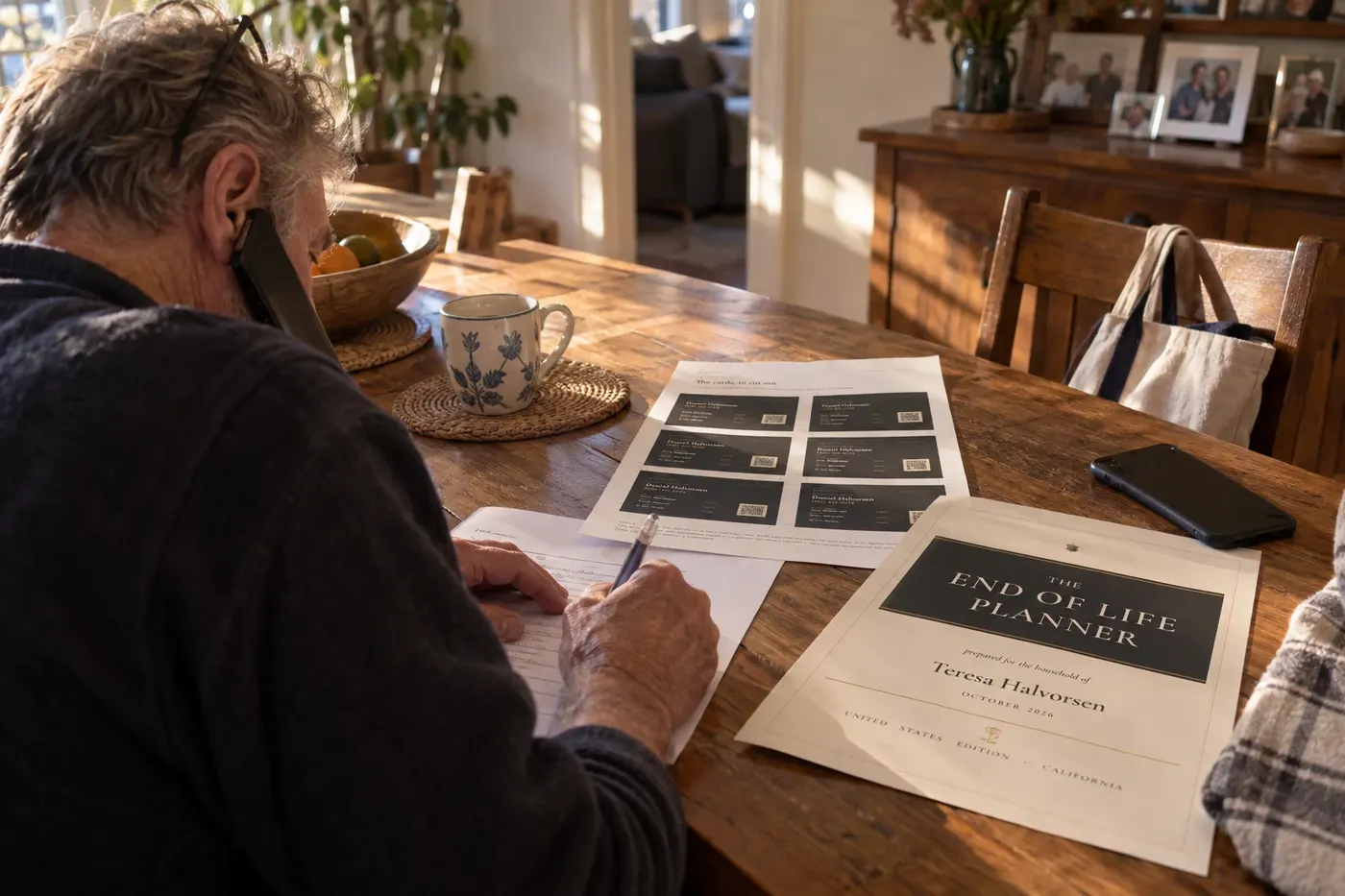
§21A printable next-of-kin organizer: The End of Life Planner
If you would rather not start from blank folders, this is the printable version we make. It is a PDF you print on Letter paper, or type into on a computer.
Each planner is one state's edition, with that state's sheet and nothing from another state.
Phones and accounts. Where the passcode is kept, who your Apple Legacy Contact is, and where the recovery codes are. Apple can’t unlock a phone for your family, so the way in is written down beforehand.
Records sheets. Bank and card accounts, beneficiary designations, insurance, retirement accounts, vehicles, property and how its title is held, the safe-deposit box, and the online accounts your family would need to find. A ruled line to write on by hand, or a field to type into, for each one.
Who to tell, and how. The federal agencies, the three credit bureaus, banks, custodians and insurers: how each one says it wants to hear of a death, in its own words, with the date we read its page. Some take no letter at all, and the map says which.
What passes outside a will. The kinds of thing that usually pass outside a will: beneficiary designations, joint ownership, trusts, and accounts that go on death to a named person. Described in general, so your family knows what to look for and who to ask; never a ruling on yours.
Eleven notification letters. Blank letters for a bank or credit union, a card issuer or lender, one credit bureau, a life insurer, a retirement or investment account, an employer, a pension payer, a service provider, a home lender or landlord, another insurer, and the Department of State for a passport. Each reports the death and asks only for what that organization needs.
Your state’s sheet. One sheet for the state the planner is bought for: what that state’s own court and records offices publish about probate, small estates and death certificates, each as the body states it, with the date it was checked. Nothing from another state.
The cards. Cut-outs with the first-call person’s name and number: one for a wallet, one for the spot by the phone.
It does not replace the box. It is the paper that goes at the front of it: what you have, where it is and who to tell. The originals stay in your own box or drawer.
It is not a will, and it decides nothing for you.
US$45
On sale now in every state and the District of Columbia.
Fifteen kinds of thing: identity papers, the will and powers of attorney, health care directives, people to call, money, insurance, the home and vehicles, taxes, Social Security and Medicare, work and pensions, digital accounts, pets, funeral wishes, business papers, and a note of where the originals and keys are.
Take a file box or a binder, fifteen folders and some labels. Put a copy of each paper in its folder and write where the original is. Keep the box in one named place at home. Tell two people where it is. Read it again once a year.
Yes. The one-page category sheet on this page is free to print, with no email. It lists the fifteen categories, with a box to tick and a line for where each folder is kept.
At home, in one named place the person who will need it can reach. Tell two people. Keep a copy of the category sheet outside any safe deposit box.
No. It has no legal power of its own. The will, the powers of attorney and the health care directives are separate signed papers. The box holds them, or says where they are.
Nearly. The difference is the container. A box holds originals and keys. A binder holds copies and lists. Both answer one question for your family: where is everything?
No. Write the route, not the key: which password manager you use, who can reach it, and which phone the codes arrive on. A box is meant to be found.
For anyone who would rather their family found it all in one place than went looking.
A couple. A parent. An adult child and a parent, doing it together. One sitting starts it; keep it current, and tell someone where it is.
“Apple can’t help remove the passcode lock without erasing the device.”
Apple says so on the page where families send it the death certificate. The first section of the planner is the one that stops that: the passcode, the Legacy Contact and the recovery codes, written down while you still can.